
On This Page
- Why Sacramento homeowners should care about UV, not just heat
- Does a solid aluminum patio cover block UV rays?
- The sun doesn't care where your family sits. Your patio cover should.
- A real Rocklin patio: what the photographs show
- Why side shade and landscaping can matter
- Your concrete patio matters, too
- Solid, insulated, lattice, or combination: which roof makes sense?
- What Vlad considers before recommending a patio cover
- Three quick questions before you choose a patio cover
- Your family deserves a backyard worth using
Your backyard should be where your family comes together. So why does Sacramento sunshine sometimes make it the last place anyone wants to be?
The concrete gets hot. Afternoon sunlight hits the patio furniture. And the spot where everyone wants to gather becomes uncomfortable.
A patio cover can change that. But not every design creates shade where and when your family needs it most.
And there's something more important than comfort: helping protect your family from unnecessary UV exposure.
Here's what medical research actually says about solid patio covers—and what a real installation in Rocklin can teach us about planning a better-shaded backyard.
Why Sacramento homeowners should care about UV, not just heat
Sacramento summers give homeowners plenty of reasons to seek shade. According to NOAA's 1991–2020 climate normals for the Sacramento 5 ESE station, the area averages approximately 90 days a year when the high temperature reaches 90°F or more.
But here's the distinction: heat and ultraviolet (UV) radiation are not the same thing. A mild or cloudy day can still bring meaningful UV exposure. The Centers for Disease Control and Prevention (CDC) explains that excessive UV exposure can damage skin cells and causes most skin cancers.
The World Health Organization (WHO) also links excessive UV exposure to skin cancers, premature skin aging, and some eye conditions. You can't reliably judge UV exposure by how hot a patio feels.
Heat
What your body feels.
UV Radiation
Invisible radiation that can damage skin.
≠
HEAT ≠ UV EXPOSURE
A cooler day does not necessarily mean low UV exposure.
HEAT ≠ UV EXPOSURE. Feeling cooler doesn't automatically mean you're protected from UV.
What the numbers tell us
67
Median Age at Melanoma Diagnosis
United States, SEER data, 2019–2023
This is a national population statistic, not an individual's predicted diagnosis age.
67 — Median age at melanoma diagnosis in the United States, 2019–2023.
That's the figure reported by the National Cancer Institute's SEER program. It's a national population statistic—not the age when any individual is expected to develop melanoma, and not a Sacramento-specific risk estimate. It reminds us why sun protection matters throughout life.
10 AM–4 PM — The hours when UV is generally strongest in the continental United States during daylight saving time.
That guidance comes from the CDC. During standard time, the corresponding general window is 9 AM–3 PM. These are broad recommendations, not a solar measurement for an individual property. For daily conditions, consult the EPA UV Index. Sun protection is recommended when the local UV Index reaches 3 or higher.
The point isn't to avoid enjoying the outdoors. It's to plan shade where family members will actually spend their time—and to keep using other sensible sun-protection measures.
Does a solid aluminum patio cover block UV rays?
Yes. An opaque, solid aluminum roof blocks direct UV radiation from passing through the roofing material.
The American Academy of Dermatology (AAD) states in its shade-structure guidance that hard-top roofs made of metal or wood block 100% of direct UV radiation.
100%
Direct UV Blocked Through Solid Metal Roofing
Solid, opaque roofing blocks direct UV from passing through the roof material.
Does not mean 100% UV protection beneath the patio cover.
Source: American Academy of Dermatology
100% of direct UV blocked through an opaque hard roof does NOT mean 100% UV protection beneath the patio cover.
Why? UV can still reach someone in the shade from open sides and through scattering or reflection from surrounding surfaces. That's why the CDC recommends shade alongside sunscreen, protective clothing, hats, and sunglasses.
A solid patio cover is a permanent overhead shade structure, not a medical device and not a substitute for other sun-safety habits.
The sun doesn't care where your family sits. Your patio cover should.
Think about how your family really uses the patio. Coffee in the morning. Grandkids playing after lunch. A table full of friends for dinner. The same roof can cast a different pattern of shade at each of those times.
That's why selecting a patio cover shouldn't begin and end with the color or material. The placement and proportions matter.
Illustrative concept
Morning
Midday
Late Afternoon
SUN ANGLE CHANGES. SHADE CHANGES.
Illustrative example. Actual shade depends on property orientation, roof dimensions, time of day, and season.
- ·House orientation: A patio facing south experiences sunlight differently from one facing east or west.
- ·Roof height and projection: A deeper roof can change where the shade falls; a higher open edge can let in more low-angle sunlight.
- ·Season and time of day: The sun changes elevation and direction. Shade at noon doesn't guarantee shade in late afternoon.
- ·Family routines: The important question is whether shade reaches the chairs, dining table, and play areas when people use them.
- ·Post placement, drainage, and architecture: A useful design also needs clear circulation, appropriate supports, and a roof that works with the existing home.
A blanket promise to shade an entire patio all day isn't credible without knowing the property. Thoughtful design starts with the site and the homeowner's priorities.
A real Rocklin patio: what the photographs show
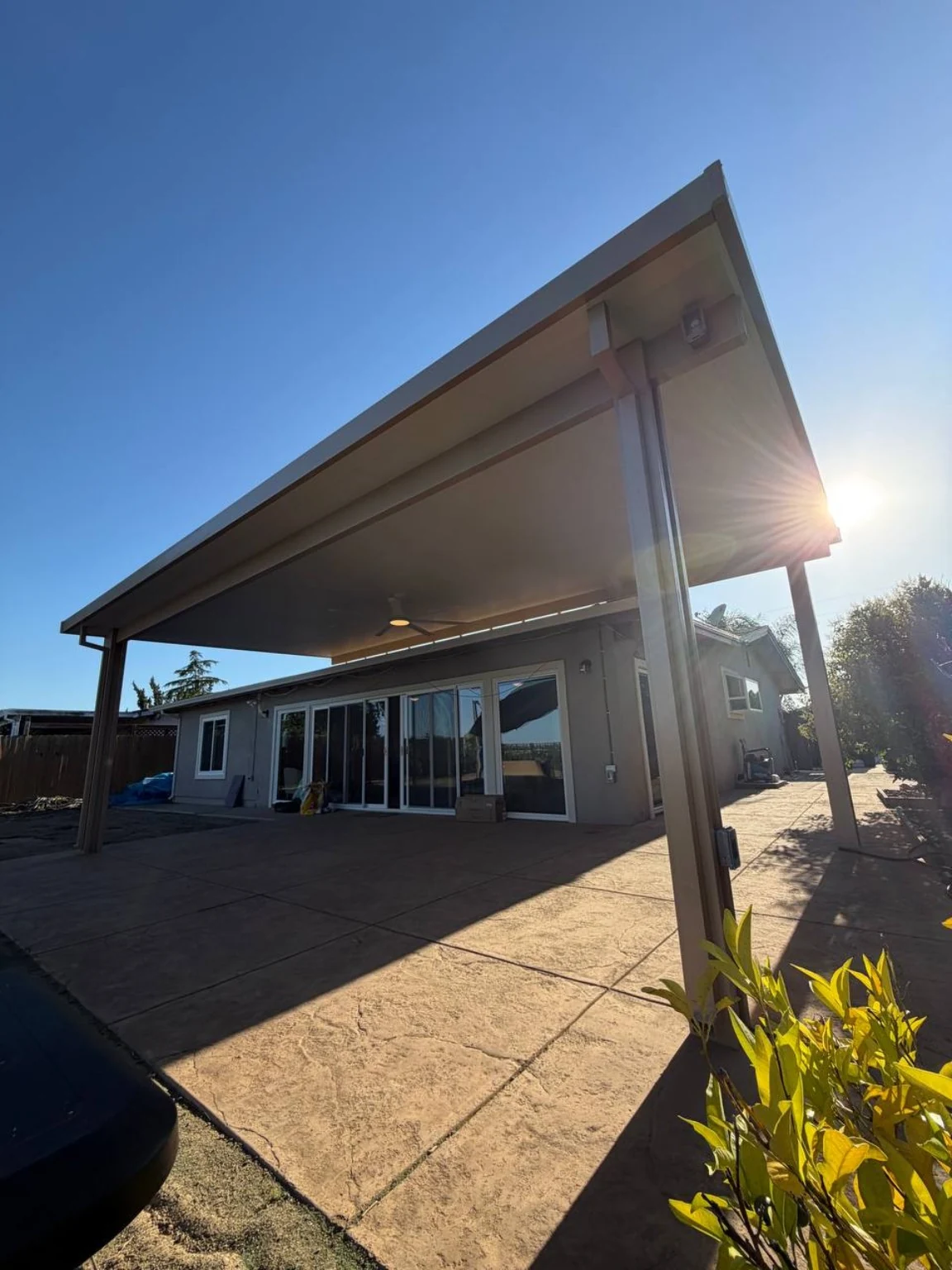
This completed project by Under Cover Patio & Construction Inc. features a solid aluminum cover extending above a concrete patio in Rocklin, California.
Look closely at the roof's elevated front edge, the support posts near the perimeter, and the visible line separating sunlit concrete from the area in shade.
That boundary isn't a theoretical calculation. It's a real shadow captured in a photograph. It shows the roof blocking direct sunlight over part of the patio at that moment. It does not prove how many hours the space remains shaded throughout the day.
This infographic illustrates general design principles. It is not a measured UV study or site-specific solar calculation.
Four details worth noticing
1. A continuous overhead barrier. Unlike a lattice roof, the solid panels leave no open gaps through which direct sunlight passes.
2. An airy roofline. The elevated front edge keeps the space feeling open. Height, however, must be balanced against how much angled light can enter.
3. Support posts near the perimeter. This preserves much of the central patio for furniture and easy movement.
4. An honest view of shade. The photograph shows both shade and sunlight, reminding us that good planning means understanding the space, not promising impossible results.
Where would you want the shade to fall in your own backyard—at breakfast, during afternoon visits, or around the dinner table?
Wondering how much shade your own patio could have?
Vlad can help you explore roof options and placement based on your home's layout and the way your family uses the space.
Why side shade and landscaping can matter
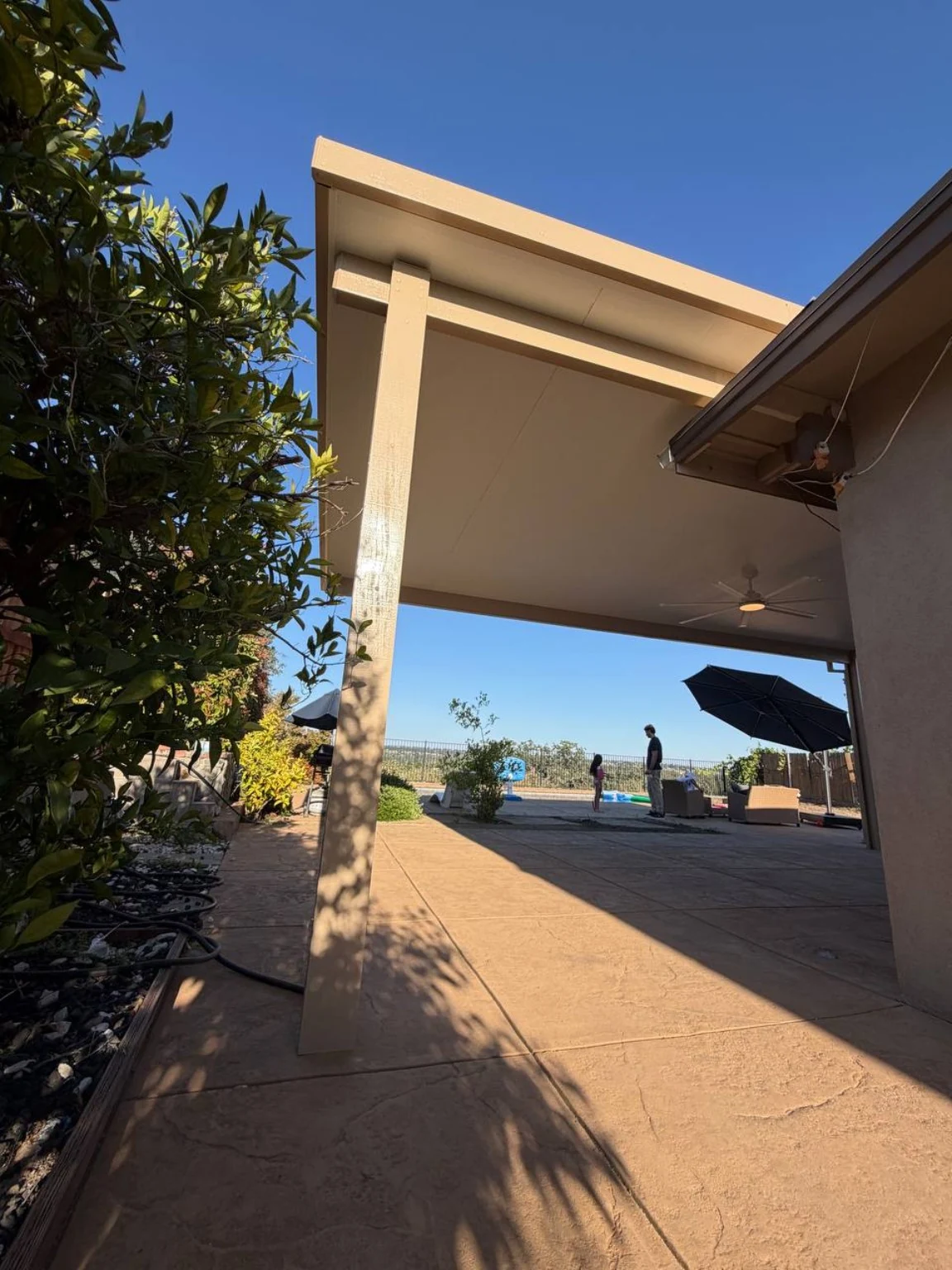
Even with a solid roof, low-angle sunlight and scattered UV can enter from open sides. On some properties, compatible side screens, privacy panels, or thoughtfully placed trees and shrubs may provide additional shade.
Researchers D. J. Turnbull and A. V. Parisi investigated this in a peer-reviewed study published in the Journal of Photochemistry and Photobiology B: Biology (2005). Their measurements showed that side protection, including properly placed evergreen vegetation, could reduce scattered UV under the conditions studied. The results depend on vegetation density, positioning, and sun angle; they should never be presented as a guaranteed reduction for a particular backyard. Read the study on PubMed.
A later peer-reviewed review by Parisi and Turnbull (2014) reinforces the larger point: effective shade depends on multiple design factors, and the amount of UV reaching people beneath a structure is not explained by roof material alone.
Think about shade in three dimensions: the overhead roof, openings along the sides, and the outdoor areas people use most.
Your concrete patio matters, too
There's one more factor that's easy to miss: some UV can be reflected by the ground and nearby surfaces.
The CDC notes that UV can reflect from surfaces including cement. However, not all concrete behaves the same way, and its visible color cannot tell you an exact UV-reflection percentage.
So a homeowner shouldn't assume that a lighter-looking patio necessarily offers better UV protection—or that a photograph proves how much UV the concrete reflects.
The practical lesson is to look at the whole setting: roof, paving, nearby walls, planting, and side exposure. A good shade plan considers them together.
Three paths of sun exposure
1. Direct Sunlight
A solid roof blocks direct sunlight passing through its surface.
2. Side Exposure
Low-angle sunlight and scattered UV can enter from open sides.
3. Reflected UV
Nearby surfaces can reflect some UV radiation.
BETTER SHADE STARTS WITH THE WHOLE OUTDOOR SPACE.
Sources: CDC Sun Safety · Turnbull & Parisi (2005)
Solid, insulated, lattice, or combination: which roof makes sense?
Solid
Continuous overhead shade.
Insulated
Overhead shade with added roof insulation.
Lattice
Partial shade with natural light.
Combination
Different shade zones in one design.
Solid aluminum patio cover. A continuous opaque roof is a strong choice when blocking direct overhead sunlight is the priority. It provides reliable roof coverage while leaving the sides open.
Insulated aluminum patio cover. It provides the same basic opaque overhead barrier while adding roof insulation to help reduce heat transfer through the roof assembly. Actual comfort improvements depend on the installation and conditions; insulation doesn't eliminate UV entering from the sides.
Lattice patio cover. Open slats create patterned, partial shade and let direct sunlight through the gaps. That may be desirable for nearby plants or a more open appearance, but the UV coverage is different from a solid roof.
Combination patio cover. Solid and lattice sections can create distinct areas—for example, more shade where the family eats and partial sun near plants.
Why aluminum? Properly finished aluminum systems require comparatively little maintenance and avoid some wood-related problems, such as rot and termite damage. The health-related advantage discussed here, however, is solid shade, not aluminum being medically superior to every other opaque roofing material.
What Vlad considers before recommending a patio cover
Vlad Bilous, Founder & Lead Estimator of Under Cover Patio & Construction Inc., personally visits properties, takes on-site measurements, and talks with homeowners about how they want to use their outdoor spaces.
He looks at how sunlight moves across the yard, the home's orientation, available patio space, roof height and projection, support-post positioning, drainage, and architectural fit. He also considers practical project requirements and the household's priorities before recommending a suitable design.
Planning around your family
Sun Exposure
House orientation and changing shade.
Family Routine
Where and when the outdoor space is used.
Roof Design
Height, projection, and roof type.
Space & Supports
Usable area and post placement.
Home Integration
Architecture, drainage, and property requirements.
A family that spends afternoons outside with children or grandchildren may have different shade priorities than homeowners who mainly use the patio for evening meals. Some want broad, continuous overhead coverage. Others want to keep a sunny area for planting.
A patio cover should be planned around the way you live—not the other way around.
Three quick questions before you choose a patio cover
Can a patio cover prevent skin cancer?
No patio cover can guarantee prevention. But reducing excessive UV exposure is an important sun-safety measure. Solid opaque roofing blocks direct UV through the roof surface, while other protection is still important because UV can reach people from open sides and reflected surroundings.
Will a patio cover make my backyard cooler?
Shade can reduce the direct solar heating of people and surfaces. But air temperature beneath a patio cover depends on ventilation, roofing materials, weather, and surrounding conditions. A specific temperature reduction should never be guaranteed without measurements.
Can landscaping improve side protection?
Yes, when planting is sufficiently dense and appropriately positioned. Peer-reviewed research supports the principle, not a guaranteed UV reduction at any particular home.
Your family deserves a backyard worth using
Your patio is where ordinary moments become good memories: breakfast before work, a birthday dinner, an afternoon with the grandkids.
The best patio cover isn't simply the one that looks beautiful. It's one thoughtfully planned around the people who will spend their time beneath it.
You can replace furniture. You can repaint a fence. But you can't put a price on your family's health. Creating better shade is one practical way to reduce unnecessary direct sun exposure while making outdoor time more enjoyable.
Under Cover Patio & Construction Inc. helps homeowners in Rocklin, Antelope, Sacramento, Roseville, and surrounding communities explore aluminum patio covers suited to their homes and routines.
Because your family's comfort matters. And helping protect their health matters even more.
Make room for more family time
With shade planned around the people who matter most.
BECAUSE YOUR FAMILY'S HEALTH MATTERS MORE.
Create a more comfortable outdoor space with shade planned around your home and the people you love.
Sun-safety note: This guide provides general educational information, not personal medical advice. A patio cover is not a substitute for sunscreen, protective clothing, or advice from a dermatologist.
Scientific and official sources
- 1.American Academy of Dermatology — Shade Structure Grant FAQs — hard-top roofing and direct UV radiation.
- 2.CDC — Sun Safety Facts — skin cancer risk, reflected UV, protective measures, and general strongest-UV hours.
- 3.World Health Organization — Ultraviolet Radiation — health effects of excessive UV exposure.
- 4.National Cancer Institute / SEER — Melanoma of the Skin — median age at melanoma diagnosis in U.S. registry data.
- 5.Turnbull & Parisi (2005), *Journal of Photochemistry and Photobiology B* — measurements of side protection and scattered UV.
- 6.Parisi & Turnbull (2014), *Photochemistry and Photobiology* — peer-reviewed review of effective shade provision.
- 7.U.S. Environmental Protection Agency — Learn About the UV Index — understanding UV forecasts.
- 8.NOAA — Sacramento 5 ESE Climate Normals, 1991–2020 — local temperature statistics, not UV measurements.