
On This Page
- The Science Is Simple: Stop Some of the Heat Before It Gets Inside
- Why the Position of Your Patio Cover Matters So Much
- A Real Elk Grove Project: Two Covers, Two Different Jobs
- Solid, Insulated, or Lattice: Which One Makes More Sense?
- So, How Much Could You Actually Save?
- Let's Find the Right Shade for Your Home
- Research Behind This Article
The right patio cover can give you more than a comfortable place to relax. When thoughtfully positioned, it may also help keep unwanted summer heat out of your home.
Picture a summer afternoon in the Sacramento area. The sun is beating down on your backyard, your sliding glass door is getting direct sunlight, and the air conditioner is working to keep the house comfortable.
You might be thinking about a patio cover because you'd love to spend more time outside. But here's a question worth asking:
Could the right patio cover also help reduce your air-conditioning costs?
The answer is yes, potentially. And the reason comes down to something surprisingly simple: where the sunlight goes before it reaches your home.
The Science Is Simple: Stop Some of the Heat Before It Gets Inside
When sunlight passes through windows and glass doors, some of that energy becomes heat inside your home. This is called solar heat gain.
According to the U.S. Department of Energy, about 76% of the sunlight striking standard double-pane windows enters and becomes heat during the cooling season. This figure is also explained by the Attachments Energy Rating Council.
That's why outdoor shade can make a difference.
U.S. Department of Energy / NREL residential research for hot-dry climates lists shaded south-, west- and east-facing glass and minimized unshaded west-facing glass among the passive strategies for reducing cooling loads.
There's an important distinction: this research is about solar heat gain through windows and cooling loads, not a guaranteed reduction in your electricity bill. It also concerns exterior window shading in general, not every patio cover design.
The principle is still valuable. If a patio cover shades glass that would otherwise receive direct sunlight, it can reduce the amount of solar heat entering that part of your home.
And less unwanted heat may mean less cooling work for your air conditioner.
Why the Position of Your Patio Cover Matters So Much
Not every home needs the same shade.
A roof that works beautifully for one backyard might leave another home's windows exposed during the hottest part of the day.
For example, the afternoon sun often comes in at a low angle on the west side of a home. A roof can provide excellent overhead shade while still allowing sunlight to reach a window from the side.
The Pacific Northwest National Laboratory's Building America guidance explains why roof depth, window placement, and the sun's direction are so important.
That's why we don't believe in choosing a patio cover based on appearance or square footage alone.
At Under Cover Patio & Construction Inc., Vlad looks at how the sun moves across your property, which areas you want to protect, and how your family plans to use the space.
Sometimes the best choice is a solid insulated roof. Sometimes it's an open lattice cover. And sometimes, as one of our Elk Grove projects shows, it's a combination of both approaches using two different covers.
A Real Elk Grove Project: Two Covers, Two Different Jobs
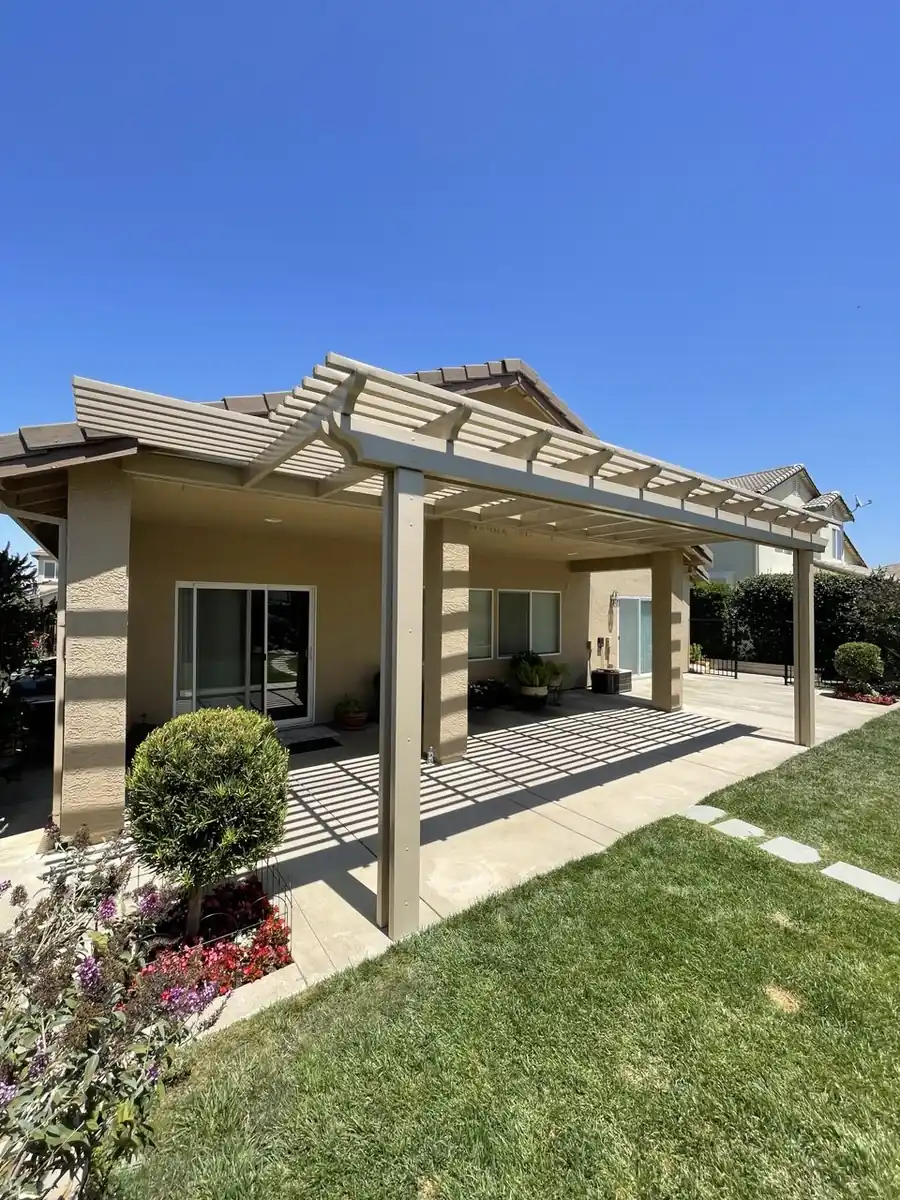
At a home in Elk Grove, the homeowners had two very different needs.
They wanted an attractive outdoor structure that would provide a little shade without closing off the backyard.
But there was another concern: direct sunlight was reaching the area near their bedroom entrance. According to Vlad, the bedroom was getting so warm that the air conditioner was struggling to keep up.
Instead of treating the whole yard the same way, the project used two different aluminum patio covers.
An open lattice cover provided filtered shade and an architectural feature for the backyard. A solid insulated cover was installed to provide more substantial protection near the bedroom entrance.
As Vlad explained the project:
“We used two patio covers: a lattice design for a little shade and its decorative look, and an insulated cover to protect the bedroom entrance from direct sun. The room had been getting very hot, and the AC was struggling to keep up.”
We haven't measured the home's electricity use before and after installation, so we can't claim a specific energy saving from this project.
What the project does show is something important: a patio cover should be designed around the problem you're trying to solve.
A beautiful backyard matters. So does having a comfortable home.
Solid, Insulated, or Lattice: Which One Makes More Sense?
If your main concern is blocking direct overhead sunlight, a solid roof usually provides more continuous shade than an open lattice structure.
An insulated aluminum patio cover adds a thermal core to the roof panels, helping limit heat transfer through the roof itself. That can improve comfort beneath the structure.
A lattice cover has a different advantage: it lets in filtered daylight and maintains a more open feeling.
Neither option is automatically the best for every house.
The right decision depends on your windows, sun exposure, patio layout, and what you want your outdoor space to feel like.
It's also worth considering the seasons. Permanent shade can reduce useful winter sunlight, so good design balances summer protection with natural light throughout the year.
So, How Much Could You Actually Save?
That's the question everyone wants answered.
The potential savings depend on how much sunlight reaches your windows today, how effectively a new cover shades them, your home's insulation, air-conditioning usage, and your electricity rate.
For Sacramento-area homeowners served by SMUD, timing also matters. Under SMUD's Time-of-Day rate schedule, electricity costs more during weekday summer peak hours from 5 to 8 p.m. Other rate plans may differ.
Reducing unwanted afternoon heat could be helpful, but there's no honest way to promise a specific monthly dollar saving without evaluating the home and its energy use.
And that's okay. A patio cover doesn't have to pay for itself through electricity savings alone to make a meaningful difference.
You may also gain something you'll appreciate every day: a shaded place for morning coffee, more comfortable afternoons outside, and a backyard your family actually wants to use.
Let's Find the Right Shade for Your Home
You don't have to figure out roof styles, sun angles, or construction details on your own.
When you contact Under Cover Patio & Construction Inc., Vlad can visit your property for a free, no-obligation on-site estimate.
He'll listen to what you'd like to improve, look at your windows and patio, take measurements, and explain the options that make sense for your home.
You'll have the opportunity to discuss solid, insulated, lattice, or combination designs, along with any additional features you may want. Once the details are confirmed, we'll prepare a written estimate so you can understand your options before making a decision.
Our goal isn't to sell you the biggest patio cover. It's to help you choose one that makes your outdoor space more enjoyable and gives your home the shade it actually needs.

Vlad Bilous
Founder & Lead Estimator
Under Cover Patio & Construction Inc.
California CSLB #1152161
Vlad helps homeowners choose aluminum patio covers based on their home’s layout, sun exposure, and the way they want to enjoy their outdoor space.
Ready to make your backyard more comfortable?
Request Your Free Patio Cover Estimate or call Vlad at (916) 301-3756.
Under Cover Patio & Construction Inc. — California CSLB License #1152161. Serving Elk Grove, Sacramento, Roseville, Rocklin, Carmichael, and communities throughout Greater Sacramento.
Research Behind This Article
- ·U.S. Department of Energy / NREL — Building America Residential System Research Results: Achieving 30% Whole House Energy Savings Level in Hot-Dry and Mixed-Dry Climates (2006). Residential research discussing shaded glass, overhangs and solar heat gain in hot-dry climates.
- ·Attachments Energy Rating Council — Energy and Comfort. Includes the DOE-sourced figure on sunlight passing through standard double-pane windows.
- ·PNNL / Building America — Shading and Solar Control for Windows and Skylights. Official technical guidance on exterior architectural shade, overhangs, window placement, and cooling loads.
- ·Pérez-Carramiñana et al. (2024), Buildings — Influence of Sun Shading Devices on Energy Efficiency, Thermal Comfort and Lighting Comfort. Institutionally hosted copy (Universitat Politècnica de València). Research on exterior shading and cooling demand in a Spanish educational building. Its numerical results are not estimates for California patio covers.
- ·SMUD — Rate Details and Holidays. Official residential Time-of-Day rate information.
Research reviewed October 29, 2026. Energy performance and savings depend on individual property conditions. No specific savings are guaranteed.